The Real Reason Most People Struggle To Change
Most people believe they need more motivation.
They think they need to feel inspired.
They think they need greater discipline.
They think they need stronger willpower.
Yet motivation is one of the least reliable tools for creating long-term change.
Motivation comes and goes.
Some days you feel motivated.
Some days you do not.
Some days you feel unstoppable.
Other days you struggle to begin.
If lasting change depended entirely on motivation, very few people would achieve meaningful results.
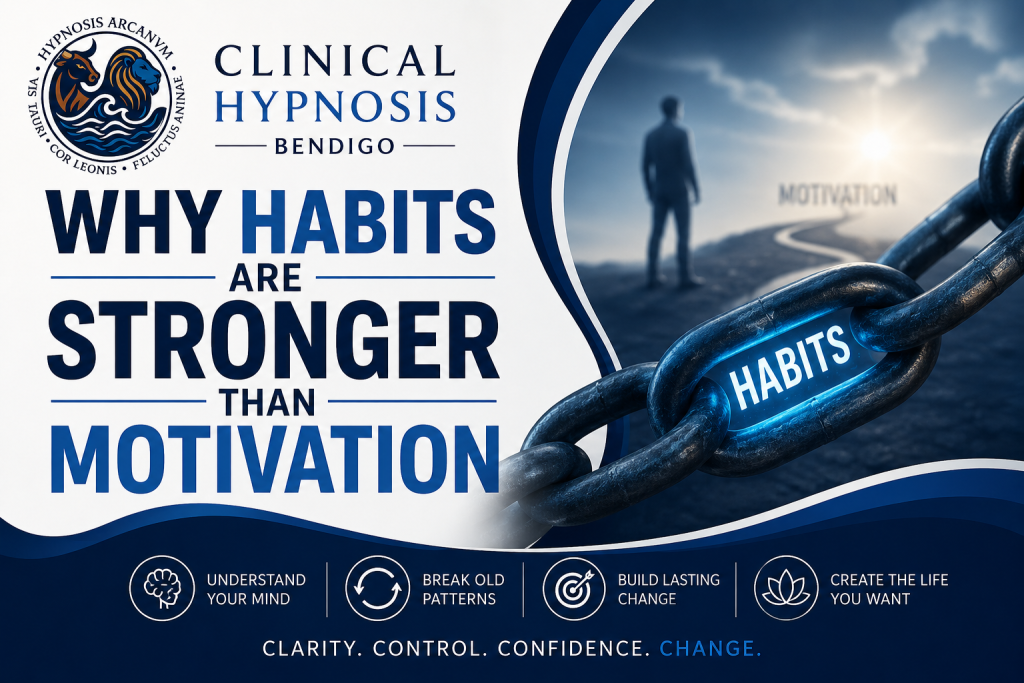
The truth is that habits are often far stronger than motivation.
At Clinical Hypnosis Bendigo, many clients discover that changing behaviour becomes easier when they focus on habits rather than feelings.
Motivation Is Emotional
Motivation is largely emotional.
It is influenced by:
- Energy levels
- Sleep quality
- Stress levels
- Mood
- Environment
- Life circumstances
This means motivation naturally fluctuates.
A person may feel highly motivated after watching an inspiring video.
They may feel motivated after a health scare.
They may feel motivated at the beginning of a new year.
However, motivation often decreases when life becomes difficult.
Stress appears.
Work becomes demanding.
Unexpected challenges arise.
The individual loses momentum.
This is where habits become important.
Habits Operate Automatically
Habits do not require motivation.
Habits operate automatically.
Think about brushing your teeth.
You probably do not need motivation.
You simply do it.
The behaviour has become automatic.
The same principle applies to many daily activities.
Driving.
Making coffee.
Checking your phone.
Locking your front door.
The brain creates shortcuts.
Once a behaviour becomes familiar, less conscious effort is required.
This is why habits are so powerful.
How Habits Form
The brain is constantly looking for efficiency.
Repeated actions create neural pathways.
The more often a behaviour is repeated, the stronger the pathway becomes.
Eventually the behaviour requires very little conscious thought.
This process helps explain why habits can feel difficult to break.
The behaviour is no longer a decision.
It has become a pattern.
Why Bad Habits Feel Easy
People often wonder why unhealthy habits seem easier than healthy habits.
The answer is simple.
The brain values familiarity.
Not necessarily what is best.
Not necessarily what is healthiest.
Familiarity.
A familiar behaviour feels safe.
Predictable.
Comfortable.
Even when it creates problems.
This explains why people often return to:
- Smoking
- Emotional eating
- Alcohol use
- Procrastination
- Negative thinking
The nervous system recognises the pattern.
The behaviour feels familiar.
The Connection Between Anxiety And Habits
Many habits begin as attempts to regulate anxiety.
Food may provide comfort.
Smoking may provide relief.
Alcohol may create temporary escape.
Avoidance may reduce discomfort.
Initially these behaviours appear helpful.
The brain remembers the relief.
The habit becomes reinforced.
Over time the individual may forget why the behaviour started.
Only the habit remains.
This is why understanding anxiety is often an important part of behavioural change.
Why Information Alone Does Not Change Behaviour
Most people already know what they should be doing.
They know they should exercise.
They know they should sleep more.
They know they should eat healthier foods.
They know they should stop smoking.
The challenge is rarely information.
The challenge is implementation.
Knowledge does not automatically create action.
Habits determine action.
This is why many intelligent people continue behaviours they know are harmful.
The habit is stronger than the information.
The Role Of The Nervous System
The nervous system constantly seeks efficiency and safety.
When stress increases, people often return to familiar habits.
The habit provides certainty.
The habit reduces decision-making.
The habit feels comfortable.
Even unhealthy habits can become a source of psychological safety.
This is one reason behavioural change can feel challenging.
The person is not simply changing behaviour.
They are changing patterns that have become familiar to the nervous system.
How Clinical Hypnosis Supports Habit Change
Clinical hypnosis helps individuals work directly with behavioural patterns.
Hypnosis is not about forcing change.
It is about creating conditions where change becomes easier.
During hypnosis, individuals enter a state of focused attention.
This allows greater awareness of automatic thoughts, habits and behaviours.
New responses can be rehearsed.
New associations can be strengthened.
Old patterns can begin losing influence.
Hypnosis And Smoking Cessation
Many smokers know cigarettes are harmful.
Knowledge is not the problem.
The habit is the problem.
Smoking often becomes associated with stress relief, comfort and routine.
Clinical hypnosis can help weaken these associations and support healthier alternatives.
Hypnosis And Weight Loss
Weight management is often influenced by automatic eating behaviours.
People eat while stressed.
They eat while distracted.
They eat from habit.
Hypnosis can help increase awareness and support healthier behavioural choices.
Small Habits Create Big Results
Many people look for dramatic solutions.
Yet long-term success is usually built through small daily habits.
Small actions repeated consistently create significant change over time.
Healthy habits accumulate.
Unhealthy habits accumulate.
The direction matters.
Behavioural Change Is A Skill
Many people believe change should happen quickly.
In reality behavioural change is a skill.
Like any skill, it improves with practice.
The goal is not perfection.
The goal is progress.
Each healthy choice strengthens a new pattern.
Each repetition reinforces a new pathway.
Over time change becomes easier.
Why Lasting Change Requires More Than Motivation
Motivation may help you start.
Habits help you continue.
This is why successful behavioural change focuses on creating systems, routines and patterns that support long-term success.
Rather than relying on feelings, individuals learn to create behaviours that become automatic.
This is where real transformation occurs.
Clinical Hypnosis Bendigo
If you are struggling with smoking, weight management, anxiety or unwanted habits, clinical hypnosis may help support positive behavioural change.
By addressing habits, beliefs and nervous system regulation, hypnosis can help individuals create healthier patterns that support long-term success.
Book an appointment with Clinical Hypnosis Bendigo to learn more about hypnosis and behavioural change.
Frequently Asked Questions
Why is motivation unreliable?
Motivation changes depending on mood, energy, stress and life circumstances.
Why are habits difficult to break?
Habits become automatic through repetition and familiarity.
Can hypnosis help change habits?
Clinical hypnosis may help individuals develop healthier behavioural patterns and reduce unwanted habits.
Are habits connected to anxiety?
Many habits develop as attempts to manage stress, anxiety or emotional discomfort.
How long does behavioural change take?
The process varies between individuals, but consistent repetition is often more important than speed.