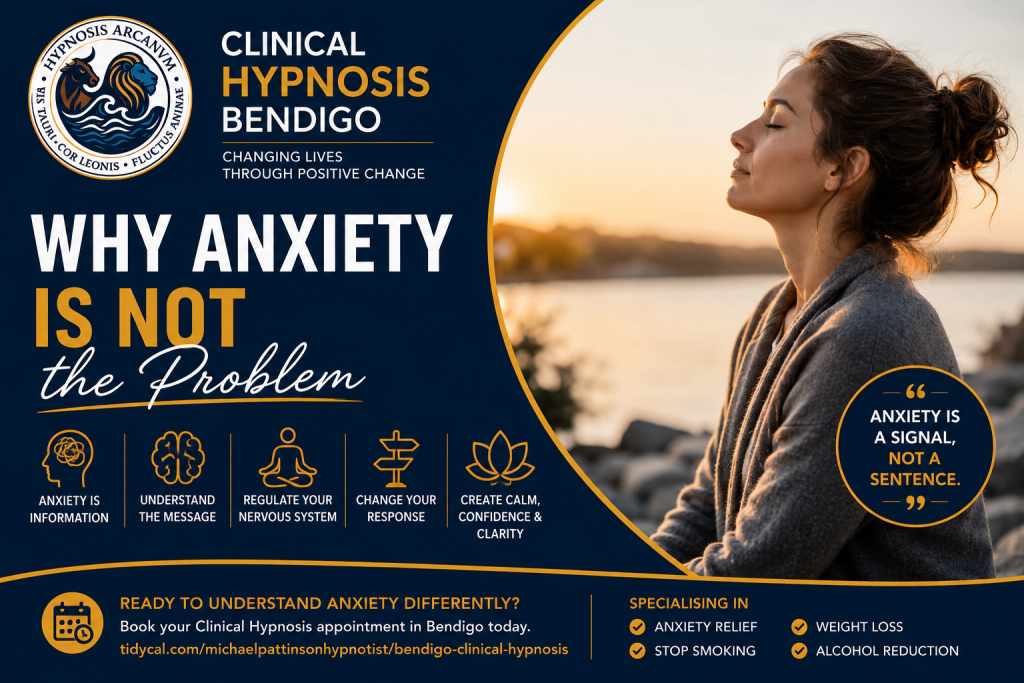
Understanding What Anxiety Is Really Trying To Tell You
Most people want anxiety to disappear.
They want the racing thoughts to stop.
They want the tension to disappear.
They want the worry to end.
They want to feel calm again.
This is understandable.
Anxiety can be uncomfortable.
It can affect sleep.
It can affect concentration.
It can affect relationships.
It can affect confidence.
However, one of the biggest mistakes people make is viewing anxiety as the enemy.
At Clinical Hypnosis Bendigo, many clients are surprised when they hear a different perspective.
Anxiety is often not the problem.
Anxiety is frequently the signal.
The real problem may be something deeper.
Understanding this distinction can completely change how people approach anxiety and behavioural change.
Anxiety Is A Normal Human Response
Anxiety is not a modern invention.
It is not a defect.
It is not evidence that something is wrong with you.
Anxiety is part of the human survival system.
For thousands of years, anxiety helped human beings survive.
It increased awareness.
It improved vigilance.
It prepared the body for action.
Without anxiety, our ancestors would have been less likely to recognise danger.
The problem today is not that anxiety exists.
The problem is that anxiety often remains active when no immediate danger is present.
The nervous system begins responding to everyday situations as though they are threats.
Deadlines.
Financial pressure.
Social situations.
Health concerns.
Uncertainty about the future.
The body reacts as though survival is at risk.
Anxiety Is Information
Think about a warning light in a car.
Most people do not become angry at the warning light.
They recognise that the light is communicating information.
The same principle applies to anxiety.
Anxiety information.
It is the nervous system attempting to communicate something important.
The question becomes:
What is anxiety trying to tell you?
Sometimes anxiety points towards chronic stress.
Sometimes anxiety points towards unresolved conflict.
Sometimes anxiety points towards exhaustion.
Sometimes anxiety points towards avoidance.
Sometimes anxiety points towards habits that no longer serve you.
When people focus only on removing anxiety, they may overlook the message.
Why Fighting Anxiety Often Makes It Worse
Many people spend years fighting anxiety.
They constantly monitor how they feel.
They become afraid of anxiety itself.
They worry about worrying.
They become anxious about anxiety.
This creates a secondary layer of stress.
The nervous system begins reacting to its own reactions.
The cycle strengthens.
The person becomes trapped.
One of the most helpful shifts is moving away from fighting anxiety and towards understanding it.
Understanding creates awareness.
Awareness creates options.
Options create change.
The Connection Between Anxiety And Behaviour
Anxiety rarely exists in isolation.
It often influences behaviour.
Many unwanted habits develop as attempts to regulate anxiety.
Examples include:
- Emotional eating
- Smoking
- Alcohol use
- Excessive social media use
- Procrastination
- Avoidance behaviours
These habits are often attempts to reduce discomfort.
The behaviour provides temporary relief.
The brain learns the pattern.
The cycle continues.
The individual may believe they have a willpower problem.
The reality is often more complex.
The nervous system is simply seeking regulation.
Anxiety And The Nervous System
The nervous system constantly asks one question.
Am I safe?
When the answer appears uncertain, anxiety increases.
The body becomes more alert.
Breathing changes.
Heart rate increases.
Muscles tighten.
Attention narrows.
These responses are not mistakes.
They are protective mechanisms.
The goal is not to eliminate these responses completely.
The goal is to help the nervous system become more flexible.
More resilient.
More adaptive.
Why Breathing Matters
Breathing is one of the fastest ways to influence the nervous system.
When anxiety rises, breathing often becomes shallow.
The body receives signals of danger.
When breathing slows, the nervous system receives different information.
The body begins recognising safety.
This is one reason breathing exercises are frequently used in anxiety management.
Simple breathing techniques can help interrupt stress responses and create opportunities for regulation.
Where Clinical Hypnosis Fits In
Clinical hypnosis is often misunderstood.
Many people think hypnosis is about losing control.
The opposite is closer to the truth.
Clinical hypnosis helps individuals develop greater awareness and control over their responses.
Hypnosis creates a state of focused attention where the mind becomes more receptive to positive change.
This can help individuals:
- Reduce anxiety
- Improve emotional regulation
- Develop healthier habits
- Strengthen confidence
- Improve resilience
- Support behavioural change
Rather than fighting anxiety, hypnosis helps people understand and respond differently to it.
Anxiety And Avoidance
One of the most common patterns associated with anxiety is avoidance.
People avoid conversations.
They avoid decisions.
They avoid challenges.
They avoid uncertainty.
Initially avoidance feels helpful.
Anxiety decreases temporarily.
However, the nervous system learns something important.
It learns that avoidance creates relief.
The behaviour becomes reinforced.
Over time anxiety often grows stronger.
The individual becomes increasingly restricted.
Breaking this cycle requires developing confidence in the ability to face discomfort rather than escape it.
Anxiety Can Become A Teacher
While anxiety is uncomfortable, it often highlights areas requiring attention.
It may reveal:
- Unhealthy boundaries
- Excessive stress
- Poor self-care
- Unresolved issues
- Unhelpful habits
- Avoidance patterns
Viewed this way, anxiety becomes less of an enemy and more of a messenger.
The goal is not to fear the messenger.
The goal is to understand the message.
Creating Lasting Change
Many people focus on eliminating symptoms.
Lasting change usually involves understanding causes.
When anxiety is viewed as information rather than an enemy, new possibilities emerge.
Individuals become less reactive.
More aware.
More resilient.
More capable of creating meaningful change.
The focus shifts from fighting anxiety to improving nervous system regulation and behavioural flexibility.
Clinical Hypnosis Bendigo
If anxiety is affecting your confidence, wellbeing or ability to enjoy life, clinical hypnosis may help support positive change.
Clinical hypnosis can assist individuals in understanding anxiety, regulating the nervous system and developing healthier responses to stress and uncertainty.
Book an appointment with Clinical Hypnosis Bendigo to learn more about hypnosis for anxiety and behavioural change.
Frequently Asked Questions
Is anxiety always bad?
No. Anxiety is a natural human response designed to promote awareness and survival.
Why does anxiety feel overwhelming?
When the nervous system remains activated for long periods, anxiety can become persistent and difficult to manage.
Can hypnosis help with anxiety?
Clinical hypnosis may help individuals regulate the nervous system and develop healthier responses to stress.
Why does avoidance increase anxiety?
Avoidance provides temporary relief but often reinforces fear and uncertainty over time.
What is nervous system regulation?
Nervous system regulation refers to the body’s ability to recover from stress and return to a balanced state.