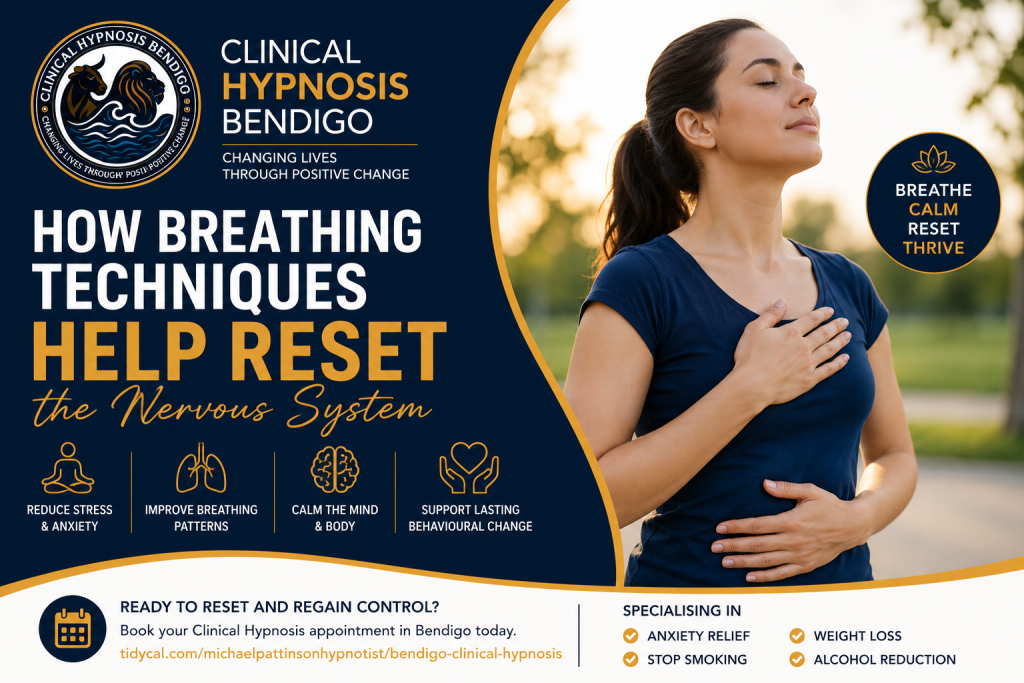
Why Most People Never Learn How to Breathe Properly
Breathing is something we do every day without thinking about it.
From the moment we are born until the day we die, breathing occurs automatically.
Yet despite breathing thousands of times each day, very few people understand the powerful relationship between breathing, anxiety and the nervous system.
Many people spend years trying to manage stress, improve focus, reduce anxiety and change unwanted habits without ever learning one of the most important tools available to them.
Their breath.
At Clinical Hypnosis Bendigo, breathing techniques are often discussed because breathing directly influences the nervous system. Unlike many bodily functions, breathing is one of the few automatic processes that can also be consciously controlled.
This makes it a powerful bridge between the mind and body.
The Nervous System Is Always Listening
The nervous system constantly gathers information from both the external world and the internal environment of the body.
It asks one fundamental question.
Am I safe?
When the nervous system believes danger is present, it activates survival responses.
These responses may include:
- Increased heart rate
- Muscle tension
- Faster breathing
- Heightened alertness
- Restlessness
- Difficulty concentrating
- Increased anxiety
These reactions are not signs of weakness.
They are signs that the nervous system is doing its job.
The challenge occurs when these responses remain active long after the threat has passed.
Many people live in a constant state of low-level survival mode.
Deadlines.
Financial pressures.
Relationship challenges.
Workplace stress.
Health concerns.
The nervous system may begin treating everyday situations as though they are dangerous.
Your Breathing Reflects Your State
Have you ever noticed what happens when you become anxious?
Breathing becomes quicker.
Breathing becomes shallower.
The chest tightens.
The body prepares for action.
The interesting thing is that the relationship works both ways.
Anxiety changes breathing.
Breathing also influences anxiety.
This means that changing the way you breathe can influence how the nervous system responds.
Breathing is not simply a symptom of stress.
It is also a tool for regulation.
Why Shallow Breathing Creates Problems
Many people spend much of their day breathing from the upper chest.
This pattern often develops gradually.
Stress increases.
The nervous system becomes more alert.
Breathing becomes shorter.
The pattern becomes habitual.
Over time the body begins treating this style of breathing as normal.
Unfortunately, shallow breathing can contribute to feelings of tension, restlessness and anxiety.
The nervous system receives ongoing signals that something may be wrong.
The body remains prepared for action.
Recovery becomes more difficult.
Sleep quality may suffer.
Emotional regulation may become harder.
Decision-making may become less effective.
The person often feels exhausted despite getting through the day.
Slow Breathing Sends a Different Message
When breathing slows, the nervous system receives a different signal.
The body begins recognising safety.
Heart rate may reduce.
Muscles may relax.
Mental activity may slow.
Attention may improve.
This is why breathing exercises are frequently used within stress management programs, mindfulness training and clinical hypnosis sessions.
Breathing helps create conditions where regulation becomes possible.
The goal is not to eliminate stress.
The goal is to improve recovery.
Why Breathing Matters for Behavioural Change
Many people are surprised to learn that breathing influences behaviour.
When individuals become anxious, they are more likely to:
- Overeat
- Smoke
- Drink alcohol
- Avoid difficult tasks
- Procrastinate
- React emotionally
When the nervous system becomes more regulated, these behaviours often become easier to manage.
The individual experiences greater control over their responses.
Rather than reacting automatically, they begin responding deliberately.
This is one reason breathing techniques can support weight loss, smoking cessation and anxiety management.
The Connection Between Breathing and Emotional Eating
Many people use food to regulate emotions.
When stress rises, food becomes comforting.
The brain learns this association.
The behaviour repeats.
Breathing exercises provide an alternative method of regulation.
Rather than immediately turning to food, the individual can first regulate the nervous system.
This creates a pause.
Within that pause, healthier decisions become possible.
The Connection Between Breathing and Smoking
Many smokers believe cigarettes help them relax.
Interestingly, part of that perceived relaxation often comes from the breathing pattern associated with smoking.
The smoker pauses.
Breathes slowly.
Steps away from stress.
The nervous system temporarily settles.
Many people discover that breathing exercises can help replace some of the regulatory functions previously associated with smoking.
Why Clinical Hypnosis Often Uses Breathing
Clinical hypnosis and breathing techniques work exceptionally well together.
Both support nervous system regulation.
Both encourage focused attention.
Both help reduce unnecessary mental noise.
Many hypnosis sessions begin with simple breathing exercises because breathing naturally encourages relaxation and concentration.
As breathing slows, individuals often become more receptive to positive behavioural change.
The mind becomes less distracted.
The nervous system becomes calmer.
This creates an ideal environment for learning new patterns.
Hypnosis Creates a Link Between Regulation and Change
One of the biggest challenges in personal development is translating knowledge into action.
Most people already know what they should do.
The challenge is consistently doing it.
Clinical hypnosis helps bridge that gap.
By helping regulate the nervous system, hypnosis creates conditions where healthier behaviours become easier to maintain.
This is why hypnosis is commonly used to support:
- Anxiety reduction
- Weight management
- Smoking cessation
- Alcohol reduction
- Confidence building
- Stress management
The goal is not simply to change behaviour.
The goal is to create a nervous system state that supports healthier behaviour.
A Simple Breathing Exercise
The following exercise can be practised almost anywhere.
- Breathe in slowly through the nose for four seconds.
- Pause briefly.
- Breathe out gently through the nose for six seconds.
- Repeat for two to five minutes.
The purpose is not perfection.
The purpose is creating a signal of safety for the nervous system.
Consistent practice often produces greater results than occasional intense effort.
Small Changes Create Big Results
Many people underestimate the power of simple habits.
They search for dramatic solutions.
Complex systems.
Perfect strategies.
Yet lasting change is often built through small, repeated actions.
Breathing is one of those actions.
Every breath sends information to the nervous system.
Every breath influences how the body responds.
Every breath creates an opportunity to regulate, recover and reset.
Clinical Hypnosis Bendigo
If anxiety, stress or unwanted habits are preventing you from achieving your goals, clinical hypnosis may help support positive behavioural change.
By combining nervous system regulation, focused attention and practical behavioural strategies, clinical hypnosis can help individuals create healthier patterns and greater emotional resilience.
Book an appointment with Clinical Hypnosis Bendigo to learn more about hypnosis for anxiety, weight loss, smoking cessation and behavioural change.
Frequently Asked Questions
Can breathing techniques reduce anxiety?
Breathing techniques may help regulate the nervous system and reduce physical symptoms associated with anxiety.
How long should I practise breathing exercises?
Even two to five minutes per day can be beneficial when practised consistently.
Why is breathing important in hypnosis?
Breathing helps calm the nervous system, improve focus and support the hypnotic process.
Can breathing help with emotional eating?
Breathing exercises may help create a pause between emotional discomfort and impulsive eating behaviours.
Does hypnosis help regulate the nervous system?
Clinical hypnosis is often used to support relaxation, nervous system regulation and positive behavioural change.