By Michael Pattinson
Clinical Hypnosis Bendigo
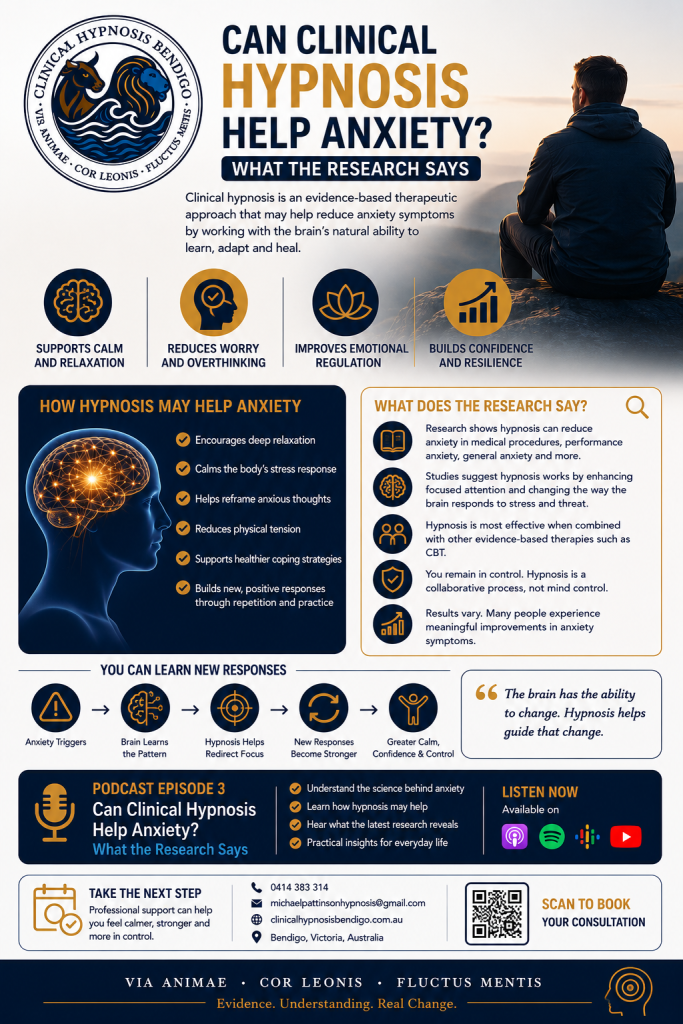
Can Clinical Hypnosis Really Help Anxiety?
Anxiety is one of the most common reasons people seek professional support.
Persistent worrying, panic, social anxiety, physical tension and feeling constantly on edge can affect relationships, work, sleep and everyday life.
A common question is:
Can clinical hypnosis actually help anxiety?
Clinical hypnosis may help some people manage anxiety symptoms when used as part of an appropriate treatment approach. Research suggests hypnosis may assist relaxation and reduce anxiety for some individuals, although it is not a cure-all and should not replace appropriate medical or psychological care.
What Is Anxiety?
Anxiety is a normal response to perceived threat or uncertainty.
When the body detects danger, it can activate the fight, flight or freeze response. Heart rate may increase, breathing can change, muscles may tense and attention becomes focused on potential danger.
This response can be useful when there is a genuine threat.
The difficulty arises when anxiety becomes frequent, excessive or continues even when there is no immediate danger.
People experiencing anxiety may experience:
Persistent worrying
Racing thoughts
Difficulty relaxing
Muscle tension
Sleep difficulties
Panic symptoms
Avoidance of situations because of fear
Difficulty concentrating
Anxiety can involve both psychological and physical responses.
How Clinical Hypnosis May Help
Clinical hypnosis uses focused attention, guided suggestions and therapeutic techniques to support changes in responses and behaviour.
During hypnosis, many people remain aware and able to communicate while focusing more closely on the task or suggestions being presented.
For some people, clinical hypnosis may support:
Relaxation skills
More constructive responses to anxious thoughts
Reduced anticipatory anxiety
Greater confidence in stressful situations
Improved ability to manage physical tension
More deliberate responses to anxiety triggers
The approach is tailored to the individual’s circumstances and goals.
Anxiety Can Become a Learned Pattern
Anxiety can become associated with particular situations through repetition.
For example, a person may repeatedly experience anxiety when:
Speaking in public
Driving
Flying
Attending medical appointments
Entering social situations
Facing a particular situation or responsibility
Over time, the person may begin anticipating anxiety before the situation even occurs.
This can create a cycle:
Situation → anxious prediction → physical response → avoidance or heightened attention → stronger expectation of anxiety.
Changing this pattern may involve learning different ways of responding to the situation and the physical sensations associated with anxiety.
Clinical hypnosis may be one tool used to support that process.
What Does the Research Say?
Research into hypnosis and anxiety has developed across a range of clinical settings.
Studies and reviews have investigated hypnosis in areas including:
Medical procedures
Dental treatment
Surgery
Cancer care
Performance-related anxiety
General anxiety symptoms
Research findings vary depending on the type of anxiety, the intervention used and the population being studied.
Overall, the evidence suggests hypnosis may be useful for some people, particularly when it is incorporated into a broader evidence-based approach rather than used as a standalone solution.
Clinical hypnosis should therefore be viewed as one possible component of care, not a replacement for appropriate psychological or medical treatment.
What Happens During a Session?
A session will vary according to the individual’s circumstances and goals.
It may include:
Discussion of the anxiety and situations that trigger it
Identifying patterns of avoidance or anticipation
Education about anxiety responses
Relaxation and focused-attention exercises
Guided therapeutic suggestions
Mental rehearsal of calmer responses
Practical strategies for managing difficult situations
Home practice where appropriate
You remain aware and able to communicate throughout clinical hypnosis.
The process is collaborative. Clinical hypnosis is not something that is simply “done” to you.
Is Clinical Hypnosis Right for Everyone?
Clinical hypnosis is not appropriate for every situation.
A qualified practitioner should consider the person’s circumstances and determine whether the approach is suitable.
People experiencing significant mental health difficulties may require assessment and treatment from an appropriately qualified healthcare professional.
Clinical hypnosis should not replace necessary medical or psychological treatment.
Where another healthcare professional is already involved, existing care should be respected and coordinated appropriately where required.
A Practical Approach to Anxiety
Managing anxiety often involves more than one factor.
Understanding triggers, changing unhelpful patterns, developing practical coping strategies and gradually building confidence can all play a role.
Clinical hypnosis may be useful for some people as part of this broader approach.
There are no guaranteed results, and no responsible practitioner can promise that hypnosis will eliminate anxiety.
The aim is to help develop more useful responses that can be practised and strengthened over time.
Key Takeaways
Anxiety is a normal response that can become excessive or persistent.
Anxiety can become associated with particular situations and responses through repetition.
Clinical hypnosis uses focused attention and guided therapeutic techniques.
Research suggests hypnosis may help some people manage anxiety.
Clinical hypnosis is best considered as part of an appropriate broader approach.
Persistent or significant anxiety may require assessment and treatment from an appropriately qualified healthcare professional.
Meaningful change usually involves practice and repetition.
Learn More About Clinical Hypnosis for Anxiety
If anxiety, persistent worry or stress is affecting your everyday life, learn more about the dedicated Clinical Hypnosis for Anxiety service available in Bendigo.
Clinical Hypnosis for Anxiety
Listen to Podcast Episode 3
Can Clinical Hypnosis Help Anxiety? What the Research Says
In this episode, Michael Pattinson explores anxiety, common patterns associated with persistent worry and how clinical hypnosis may support relaxation, behavioural change and more constructive responses to anxiety.
References
American Psychological Association, Division 30. Definition of Hypnosis.
Rosendahl, J., et al. (2024). Umbrella Review of Clinical Hypnosis.
Milling, L. S., Valentine, K. E., McCarley, H. S., & LoStimolo, L. M. (2019). Hypnosis and the Treatment of Anxiety: A Meta-analysis.
Valentine, K. E., Milling, L. S., Clark, L. J., & Moriarty, C. L. (2019). The Efficacy of Hypnosis as a Treatment for Anxiety: A Meta-Analysis.
Landry, M., Lifshitz, M., & Raz, A. (2017). Brain Correlates of Hypnosis.