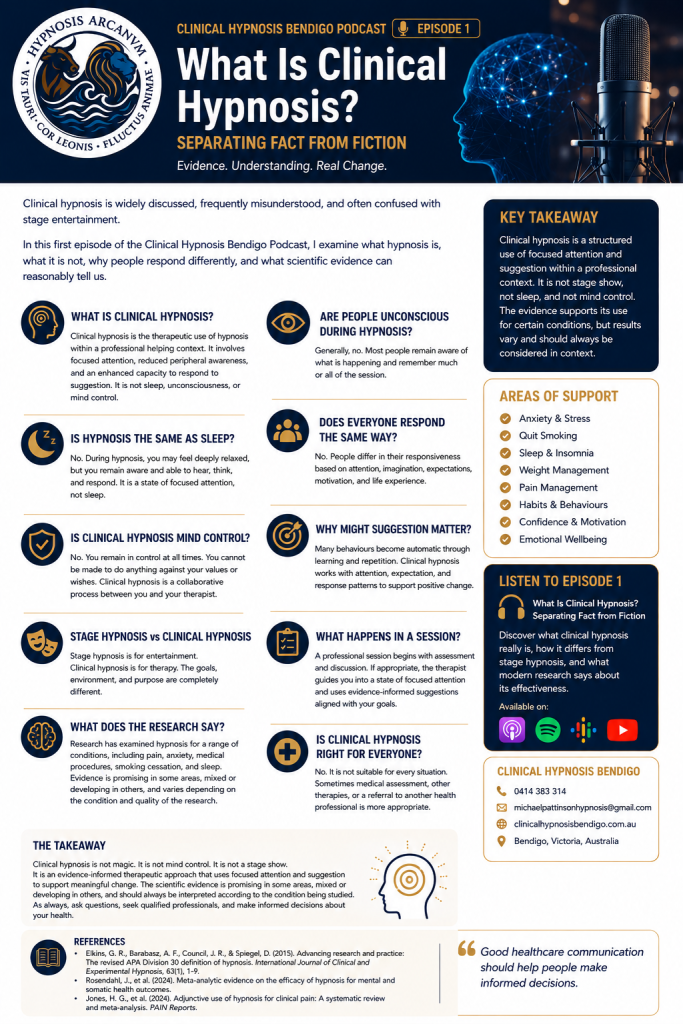
What Is Clinical Hypnosis? Separating Fact from Fiction
Clinical hypnosis is widely discussed, frequently misunderstood, and often confused with stage
entertainment.
For many people, the word hypnosis brings to mind swinging watches, loss of control, people behaving
strangely on stage, or the idea that a hypnotist can somehow take over another person’s mind. That is
not an accurate description of clinical hypnosis.
Modern hypnosis is studied within psychology, medicine and neuroscience. A widely cited professional
definition describes hypnosis in terms of focused attention, reduced peripheral awareness, and an
enhanced capacity to respond to suggestion.
In this first episode of the Clinical Hypnosis Bendigo Podcast, we examine what hypnosis is, what it
is not, why people respond differently, and what scientific evidence can reasonably tell us.
What Is Clinical Hypnosis?
Clinical hypnosis is the therapeutic use of hypnosis within a professional helping context.
One useful way to understand hypnosis is as a condition of highly focused attention. A person may
become less concerned with competing distractions and more engaged with particular ideas, imagery,
sensations or suggestions.
This does not mean that the person becomes unconscious. It does not mean the person is asleep. And
it does not mean the practitioner has taken control of the person’s mind.
The influential 2015 revised definition associated with the Society of Psychological Hypnosis described
hypnosis as a state of consciousness involving focused attention and reduced peripheral awareness,
together with an enhanced capacity to respond to suggestion. That definition moves the discussion
away from magic and towards observable psychological processes.
Is Hypnosis the Same as Sleep?
No. The language surrounding hypnosis has historically created confusion because the word itself is
connected with the idea of sleep. But hypnosis and ordinary sleep are not the same thing.
During a clinical hypnosis session, a person may hear the practitioner’s voice, notice sounds in the
room, think about what is being said, and respond to instructions. Some people feel deeply relaxed.
Others may feel physically light or heavy. Some experience vivid mental imagery. Others experience
hypnosis mainly as concentrated thinking.
There is no single sensation that proves someone is hypnotised. Clinical hypnosis is not defined by
whether someone appears to be asleep.
Is Clinical Hypnosis Mind Control?
This is probably the biggest misconception. Clinical hypnosis should not be presented as a practitioner
taking control over another human being.
The client remains a participant in the process. They bring their own expectations, motivations,
attention, interpretation and responses into the session.
A competent practitioner does not need to claim supernatural power or total control. Clinical hypnosis is
better understood as a collaborative process in which attention and suggestion are used towards an
agreed therapeutic objective.
Why Does Stage Hypnosis Look So Powerful?
Stage hypnosis is designed for entertainment. Clinical hypnosis is designed around a therapeutic
objective. That difference matters.
A stage performer works in a public environment with volunteers who have chosen to participate. The
setting, expectations, audience, selection of responsive volunteers and entertainment context all
influence what happens.
A clinical setting is fundamentally different. The person usually arrives with a specific concern or
objective. The purpose is not public entertainment. The purpose is structured therapeutic work.
Are People Unconscious During Hypnosis?
Generally, no. Many people remain aware of what is happening. They may hear the practitioner,
remember much or all of the session, notice external sounds, and have ordinary thoughts moving
through their mind.
Clinical hypnosis does not require theatrical unconsciousness.
Does Everyone Respond in the Same Way?
No. Human beings differ. People vary in responsiveness to hypnotic suggestions, just as they vary in
attention, imagery, absorption, expectations and many other psychological characteristics.
A person’s goals, expectations, motivation, presenting issue and individual response can all matter.
Responsible practitioners should not promise identical outcomes for everyone.
What Does Scientific Research Say?
The evidence is more nuanced than advertising slogans suggest. Hypnosis has been studied across a
range of psychological and physical health applications, including pain, medical procedures,
psychological symptoms and other clinical outcomes.
The correct conclusion is not that hypnosis cures everything. Hypnosis appears more useful for some
outcomes and contexts than for others, and the strength of evidence varies according to the condition,
research design and quality of available studies.
Evidence-based practice means asking: What exactly was studied? How many participants were
involved? Was there a control group? Was the study randomised? What outcome was measured? How
large was the effect? Was the finding replicated? What were the limitations?
Why Might Suggestion Matter?
Human behaviour is not controlled entirely by deliberate conscious decision-making. People develop
automatic patterns, learned responses, expectations and habits.
A person can know that smoking is harmful and still smoke. A person can know they should sleep and
still lie awake. A person can know a habit is unhelpful and still repeat it.
Clinical hypnosis attempts to work with processes such as attention, expectation, imagery, learning and
automatic responding in a focused and structured way.
What Happens During a Clinical Hypnosis Session?
A professional session should begin with assessment and discussion. The practitioner needs to
understand why the person is seeking help, what outcome they want, relevant background information,
whether hypnosis is appropriate, and whether another professional referral may be required.
If hypnosis is appropriate, the practitioner may use methods designed to focus attention. This can
involve verbal guidance, imagery, attention to breathing or bodily sensations, progressive relaxation, or
other structured techniques.
Suggestions are then developed in relation to the person’s agreed goals. The exact process varies
because people and problems vary.
Is Clinical Hypnosis Appropriate for Everyone?
No. Not every problem should be treated with hypnosis. Not every person presenting for hypnosis
should automatically receive hypnosis.
Sometimes medical assessment is required. Sometimes psychological assessment is appropriate.
Sometimes another intervention has better evidence. Sometimes multidisciplinary care is the sensible
option.
Responsible practice includes knowing when not to proceed.
Clinical Hypnosis and Evidence-Based Practice
At Clinical Hypnosis Bendigo, my position is straightforward: extraordinary claims should require strong
evidence.
The field does not benefit from pretending hypnosis is magic. It does not benefit from claiming
guaranteed cures. And it does not benefit from treating every problem as though it has the same
solution.
A more credible approach is to examine the research, explain uncertainty clearly, assess the individual,
and use clinical hypnosis where it is appropriate.
The Takeaway
Clinical hypnosis is not stage entertainment. It is not ordinary sleep. It should not be marketed as
supernatural mind control.
It is better understood as a structured use of focused attention and suggestion within an appropriate
professional context.
The scientific evidence is promising in some areas, mixed or developing in others, and should always
be interpreted according to the specific condition being studied.
If you are considering clinical hypnosis, ask serious questions. Ask what the treatment involves. Ask
whether it is appropriate for your particular concern. Ask what evidence supports the claims being
made. And be cautious of anyone promising guaranteed results.
Good healthcare communication should help people make informed decisions. That is where credible
clinical hypnosis should begin.
Listen to Episode 1
What Is Clinical Hypnosis? Separating Fact from Fiction
In Episode 1 of the Clinical Hypnosis Bendigo Podcast, Michael Pattinson examines what clinical
hypnosis really is, how it differs from stage hypnosis, why hypnosis is not the same as sleep, and what
scientific research can reasonably tell us.
Learn More
Clinical Hypnosis Bendigo
Website: clinicalhypnosisbendigo.com.au
Phone: 0414 383 314
Email: michaelpattinsonhypnosis@gmail.com
References
Elkins, G. R., Barabasz, A. F., Council, J. R., & Spiegel, D. (2015). Advancing research and practice: The revised APA Division
30 definition of hypnosis. International Journal of Clinical and Experimental Hypnosis, 63(1), 1–9.
Rosendahl, J., et al. (2024). Meta-analytic evidence on the efficacy of hypnosis for mental and somatic health outcomes.
Jones, H. G., et al. (2024). Adjunctive use of hypnosis for clinical pain: A systematic review and meta-analysis. PAIN Reports.