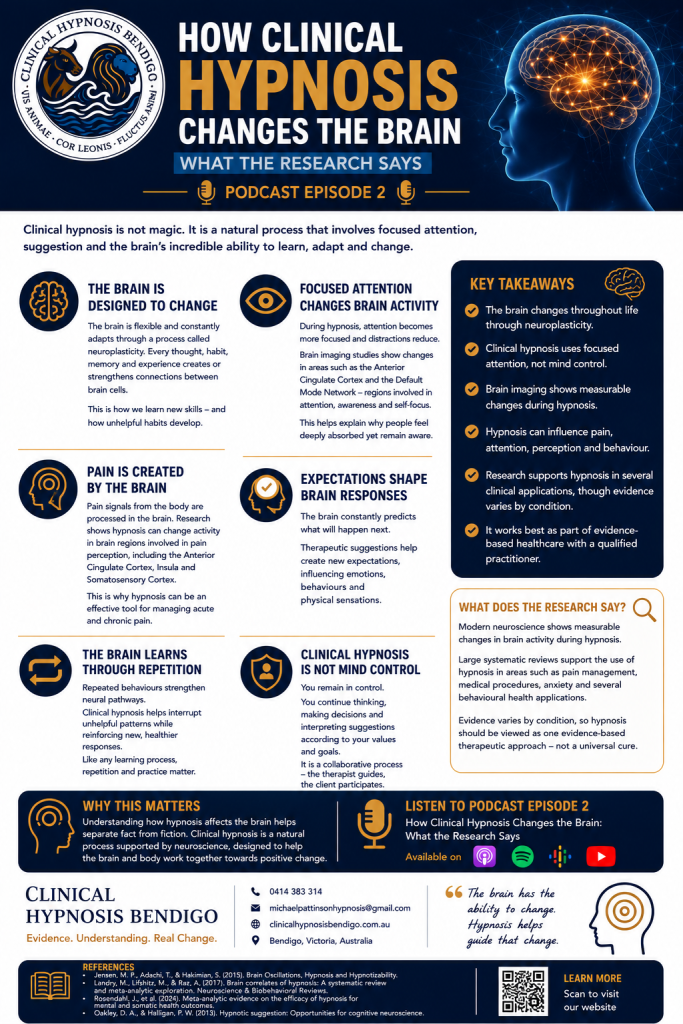
How Clinical Hypnosis Changes the Brain: What the Research Says
By Michael Pattinson
Clinical Hypnosis Bendigo
Can Clinical Hypnosis Change Brain Activity?
One of the most common questions about hypnosis is:
“What actually happens in the brain during hypnosis?”
For many years, hypnosis was surrounded by myths about trance, loss of control and mind control. Modern neuroscience has allowed researchers to study hypnosis more closely using techniques such as functional brain imaging.
Research suggests that hypnosis is associated with measurable changes in brain activity, attention, perception and the processing of information.
The science is still developing, and researchers continue to investigate exactly how these changes relate to hypnotic experience and therapeutic outcomes.
This article looks at what current research tells us and what those findings may mean for Clinical Hypnosis.
The Brain Can Change Through Learning
The human brain remains capable of adapting throughout life.
This capacity is commonly described as neuroplasticity.
Learning a new skill, developing a habit or repeatedly practising a behaviour can alter how the brain processes information and responds to particular situations.
Think about learning to drive.
At first, each movement requires conscious attention. With practice, many aspects of driving become increasingly automatic.
The same general principle applies to many learned behaviours and responses.
Clinical hypnosis does not magically rewire the brain or create permanent changes after a single session.
Instead, hypnosis may provide a focused setting in which people can practise different responses, consider alternative behaviours and reinforce goals through repetition.
Focused Attention and Brain Activity
One of the defining characteristics of hypnosis is focused attention.
During hypnosis, people may become less distracted by unrelated thoughts and more focused on particular ideas, sensations, memories or therapeutic suggestions.
Brain-imaging research has identified changes in activity and connectivity involving networks associated with attention, self-awareness and cognitive control during hypnosis.
Studies have investigated areas and networks including the anterior cingulate cortex and the default mode network.
These findings suggest that hypnosis involves measurable changes in how attention and information processing are organised.
They do not mean that a person loses awareness or becomes controlled by the hypnotist.
Hypnosis and Pain
Pain is influenced by both signals from the body and the way the nervous system processes and interprets those signals.
Research has investigated whether hypnosis can alter the experience of pain and how the brain responds to painful stimulation.
Studies have reported changes involving areas associated with pain processing, including the anterior cingulate cortex, insula and somatosensory regions.
This does not mean hypnosis eliminates the underlying cause of pain or is appropriate for every painful condition.
However, research into hypnotic approaches to pain has produced findings suggesting that hypnosis may help some people manage aspects of their pain experience, particularly when used alongside appropriate healthcare.
Expectations Influence Experience
The brain constantly uses expectations to interpret incoming information.
Expectations can influence attention, emotions, behaviour and the way physical sensations are experienced.
Clinical hypnosis makes use of focused attention and therapeutic suggestion.
For example, suggestions may direct attention towards relaxation, a different response to a stressful situation or a specific behavioural goal.
This is very different from mind control.
The person remains an active participant and interprets suggestions within their own beliefs, circumstances and goals.
The Brain Learns Through Repetition
Repeated behaviour can become increasingly automatic.
Smoking after coffee.
Eating when stressed.
Becoming anxious before public speaking.
Avoiding a particular situation because it has previously produced anxiety.
When these responses are repeated, they can become strongly associated with particular situations or triggers.
Changing an established pattern generally requires more than simply understanding it.
New responses need to be practised.
Clinical hypnosis may provide a focused environment for practising alternative responses through attention, suggestion, mental rehearsal and behavioural planning.
Like any form of learning, repetition and practice remain important.
Clinical Hypnosis Is Not Mind Control
This is one of the most important points to understand.
Clinical hypnosis does not give another person complete control over your mind.
During hypnosis, people generally remain aware and able to communicate.
They can respond to suggestions, reject suggestions and make decisions.
The practitioner provides guidance and structure, while the client actively participates in the process.
Clinical hypnosis is therefore better understood as a collaborative process involving focused attention and therapeutic suggestion.
What Does the Research Say?
Research into hypnosis continues to develop across several areas of healthcare.
Studies and systematic reviews have investigated hypnosis in areas including:
Pain management
Medical procedures
Anxiety
Stress
Behaviour change
Sleep
Other health-related applications
Brain-imaging studies provide evidence that hypnosis is associated with measurable changes in brain activity and connectivity.
However, evidence varies depending on the condition, the hypnotic intervention being studied and the population involved.
This is important.
Clinical hypnosis should not be presented as a universal treatment or as a method of permanently changing the brain.
A more accurate interpretation is that hypnosis may influence attention, perception, expectations and behavioural responses in ways that can be useful for some people.
Why This Matters
Understanding the neuroscience of hypnosis helps separate the subject from outdated myths.
Clinical hypnosis is not magic.
It is not supernatural.
It is not unconsciousness.
And it is not mind control.
Research suggests that hypnosis involves changes in attention, perception, cognitive processing and brain activity.
These changes may help explain why some people find hypnosis useful for particular therapeutic goals.
At the same time, responsible clinical practice requires realistic expectations and recognition of the limits of the evidence.
Clinical Hypnosis and Behaviour Change
Many of the problems people seek help with involve learned patterns of behaviour.
Smoking, emotional eating, anxiety responses and unwanted habits can become associated with particular situations and repeated responses.
Clinical hypnosis may be incorporated into a broader behavioural approach by helping a person focus on the response they want to develop and practise.
The goal is not to bypass conscious decision-making.
The goal is to support deliberate behavioural change through focused attention, therapeutic suggestion and practice.
Key Takeaways
The brain remains capable of change through learning and experience.
Hypnosis is associated with measurable changes in brain activity and information processing.
Focused attention is an important feature of the hypnotic experience.
Research suggests hypnosis may influence aspects of pain, attention, perception and behavioural responses.
Hypnosis does not give another person complete control over your mind.
Evidence varies between different conditions and applications.
Clinical hypnosis should be used responsibly and with realistic expectations.
Behavioural change generally requires practice and repetition rather than relying on a single intervention.
Listen to Podcast Episode 2
How Clinical Hypnosis Changes the Brain: What the Research Says
Michael Pattinson explores what modern neuroscience tells us about hypnosis, focused attention, perception, learning and therapeutic change.
Learn More
To learn more about Clinical Hypnosis Bendigo and the services available, visit the Clinical Hypnosis Bendigo website.
References
Jensen, M. P., Adachi, T., & Hakimian, S. (2015). Brain Oscillations, Hypnosis and Hypnotizability.
Landry, M., Lifshitz, M., & Raz, A. (2017). Brain correlates of hypnosis: A systematic review and meta-analytic exploration. Neuroscience & Biobehavioral Reviews.
Rosendahl, J., et al. (2024). Meta-analytic evidence on the efficacy of hypnosis for mental and somatic health outcomes.
Oakley, D. A., & Halligan, P. W. (2013). Hypnotic suggestion: Opportunities for cognitive neuroscience.
e.